

LoRa Meshtastic Node Powered by Solar Energy
Keep Your LoRa/Meshtastic Node Online — No Power Worries
Want your LoRa/Meshtastic node to stay online for the long term without worrying about power? Here’s an easy way to keep it running reliably, even in remote or off-grid locations.

Introducing the IDEA Mesh Solar Power
The IDEA Mesh Solar Power is a purpose-built expansion board for outdoor fixed wireless communication nodes. It pairs with various FoBE Quill development boards, making it simple and flexible to build reliable, solar-powered mesh nodes.
Key features include:
-
Dual 18650 battery holders
-
Solar charging interface
-
Adjustable voltage boost output
-
I²C interface
This makes it ideal for a wide range of applications, from portable devices and remote sensors to off-grid power systems.

Setting Up Your Node
In this example, we’re using the IDEA Mesh Solar Power with the Quill nRF52840 Mesh, along with Breakout SHT40and LPS22 sensors to capture real-time temperature, humidity, and atmospheric pressure data.
Choosing the right board:
-
If you want longer standby times, nRF52840 boards are ideal.
-
If you need to connect to an MQTT service over your home Wi-Fi, the Quill ESP32S3 Mesh is a great alternative.
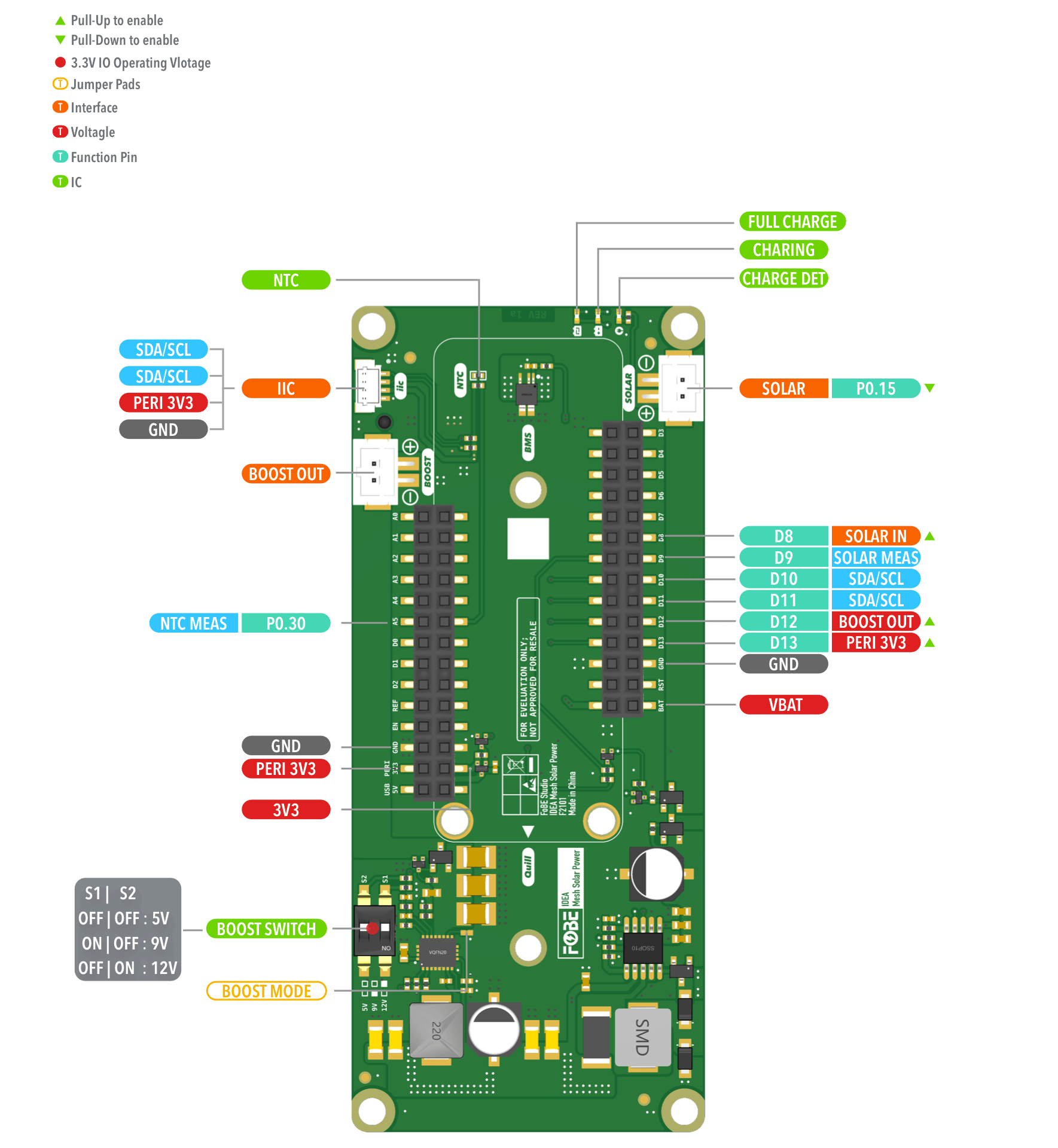
Boost Converter
The built-in boost converter lets you select the output voltage via a DIP switch — 5V, 9V, or 12V.
With two 18650 batteries connected in parallel, it can continuously provide up to 8W of power. That’s enough to run a variety of peripherals, including high-power devices like outdoor surveillance cameras.
MPPT Solar Charger
The board uses the CN3791 IC for solar charging, giving you high efficiency at an attractive price. It automatically handles trickle, constant current, and constant voltage charging.
The IC also tracks the solar panel’s maximum power point, ensuring optimal energy use even under low sunlight. Your solar-powered setup keeps running smoothly without extra attention.
Safety Features
This expansion board comes with a built-in NTC temperature sensor and a battery management IC.
You can control when to enable solar charging or the boost converter output, ensuring the battery operates safely within the right temperature range.
What You’ll Need
FoBE Quill Series Development Board x1
You can get it right here in our Store.
Get the Solar Power–compatible Meshtastic firmware at Firmware Hub.
FoBE IDEA Mesh Solar Power x1
You can get it right here in our Store.
Li-ion 18650 Battery x2
You can purchase a suitable battery from Amazon, AliExpress, or local stores. Be sure to check that the supplier is qualified and compliant.
- Rechargeable.
- Maximum charging voltage 4.2 V.
- Double-check battery polarity. Incorrect installation can be dangerous.

IPEX (U.FL) to SMA adapter cable x1
Select an extension cable length that fits your waterproof enclosure, and opt for SMA connectors with waterproof design whenever possible.
Waterproof Enclosure x1
 ideally made from UV-resistant materials. Transparent top covers are great for viewing internal components. Multiple options are available, each including a mounting bracket for the expansion board.
Grab a waterproof enclosure from our store, and we’ll throw in a matching PCB mounting bracket plus free drilling service — making it super easy to build your custom node.

Solar Charging Panel
Thanks to the FoBE Quill boards’ low-power design, we could start testing this expansion board with a small solar panel, keeping things compact while still getting reliable results.
- Operating output voltage 5V.
- Output power more than 4W.

LoRa Antenna
The LoRa antenna plays a big role in signal reach. In this setup, we’re using a high-gain fiberglass omnidirectional antenna to cover more ground horizontally, though it slightly limits how far the signal can go vertically.

Make sure to pick an antenna that matches the right frequency band.

Power Consumption & Battery Life Estimation Report
Assumptions
-
Device Specs
- Standby (LoRa RX on): 9.8 mA @ 3.7 V → P_{idle} ≈ 0.036 W
- Transmit: 175 mA @ 3.7 V → P_{tx} ≈ 0.648 W
- Transmission duration: 2 seconds per packet (if different, results will vary)
- Battery: 2 × 18650 cells, 3200 mAh each → 23.68 Wh total energy (3.7 V nominal)
-
Solar Panel Specs
- 5 V / 4 W panel
- Effective daily energy yield in Shenzhen (average 4 peak sun hours):
- Ideal (100%): 16.0 Wh/day
- Typical (85%): 13.6 Wh/day
- Conservative (70%): 11.2 Wh/day
Results Table
|
TX Interval |
Duty Cycle (2s TX) |
Avg. Power (W) |
Daily Energy Use (Wh) |
Battery-only Runtime (days) |
Solar Balance (Conservative 11.2 Wh/day) |
|---|---|---|---|---|---|
|
30 s |
6.67% |
0.077 W |
1.85 Wh/day |
~12.8 days |
Sustainable, net surplus +9.35 Wh/day |
|
60 s |
3.33% |
0.057 W |
1.36 Wh/day |
~17.4 days |
Sustainable, net surplus +9.84 Wh/day |
|
120 s |
1.67% |
0.046 W |
1.11 Wh/day |
~21.2 days |
Sustainable, net surplus +10.09 Wh/day |
Key Takeaways
-
Without solar charging
- Battery life ranges from ~13 days (30s interval) to ~21 days (120s interval).
-
With the 4 W solar panel
- Even in a conservative scenario (11.2 Wh/day effective harvest), the panel easily covers device consumption (1.1–1.9 Wh/day).
- There is a large daily energy surplus available for recharging the battery or buffering cloudy days.
Reliability
In typical Shenzhen conditions, the solar panel provides 6–10× more energy than required, meaning the device can run 24/7 continuously, with strong resilience against poor weather.
The ~23.7 Wh battery provides additional backup for several days of low solar output.